A Different Approach to Teaching the Scientific Method

In middle school science, I feel like it is important for students to really understand the steps of the scientific method. Knowing the order of the steps isn’t necessarily that important to me, but understanding each of the steps and what they entail is. I view the steps of the scientific method more as a way of thinking and problem solving than simply a way to conduct an experiment. Yes, students should know how to conduct an experiment correctly and they’ll need the steps for their future science classes. However, I realize most of my students won’t become scientists and won’t use the steps outside of school. What all of my students will need, regardless of their future career choices, is a way to approach and solve the problems that come their way. The scientific method can help with that, so that’s how I choose to present it to my students.  Consider the six steps of the scientific method.
  1. Make an observation and ask a question about it
  2. Research if needed
  3. Make a hypothesis
  4. Test the hypothesis in an experiment
  5. Record and analyze the data
  6. Write a conclusion
Students can use these steps to solve problems in their everyday, middle school lives. When I introduce the scientific method, I bring in a problem they can relate to.  I don’t know about your students, but my students are always having some kind of friendship drama.  So I walk my students through the steps of the scientific method in relation to a quarrel with a buddy.
  1. Make an observation and ask a question about it: You notice your best friend Ashleigh is being frosty to you but extra friendly to everyone else in your friend group. You ask yourself “Why is Ashleigh mad at me?”
  2.  Research if needed: You ask your friends why Ashleigh is mad.  Then you look through your Facebook posts to see if you wrote anything offensive. You see that yesterday you wrote a post saying Ashleigh’s skinny jeans don’t make her look very skinny.
  3. Make a hypothesis: You’re pretty sure Ashleigh is mad about your post. You think to yourself “If I remove the skinny jeans post and make a new Facebook post about my insensitivity, then Ashleigh will stop being mad at me.”
  4. Test the hypothesis in an experiment: As soon as you get home from school, you delete the old post and write a new Facebook post about how you made a mean and unfunny joke about a friend and how sorry you are about hurting her feelings. For good measure, you add that you’re a little jealous because you wish you had her curves.
  5. Record and analyze the data: Within an hour you have 67 likes on your new post and 13 comments praising your apology. You also have one rude comment from your annoying little brother, but he’s stupid and doesn’t matter. You get a message from Ashleigh saying that she forgives you and asks if you want to go shopping this weekend. 
  6. Write a conclusion: You learned you shouldn’t write or say mean things about your friends (or anyone else…except your annoying little brother), and apologizing and admitting you’re wrong is important. In the future, you will treat your friends better.

I think it’s important for students to realize the scientific method reaches beyond the science classroom. Besides the example above, I also use the Steps of the Scientific Method Activity with Rappers Scenarios. (You can learn more about the rapper activity here.) Using examples students can relate to and seeing how they and others can use the steps in their daily lives will help them remember the steps and actually understand them. With practice, they’ll begin to approach problems and work towards solutions differently.

In order to give my students more practice with the steps of the scientific method, I use card sorting activities. My students enjoy them and the activities are more hands on than other approaches. In my Teachers Pay Teachers store you’ll find a set of three card sorting lessons about the scientific method. Each lesson can be used in multiple ways and comes in both English and Spanish so I can reach all of my students. (You can purchase the card sorting activities here.)

Lesson Option 1
The first lesson option is a group card sorting activity.  I use this activity as practice for my students at the beginning of the year when they’re first learning about the scientific method and again after winter break as a review. In this activity, the students work together to sort the cards into the six steps of the scientific method. For each step, there are five cards: a number card, a step description card, a step explanation card, and two example cards. Take a look at the picture below to see an example of each type of card.

This activity gets students to understand what is involved in each step and see what it might look like in an experiment or a problem a student might encounter. The students can work together and discuss the groupings of the cards. After all the cards have been grouped, I have my students complete a two-part reflection sheet individually. The first part is about how well they would have done by themselves. For part two, the students pick out key words and phrases from the example cards and explain how those key words indicate what step the example was a part of. I like it because it gets the students thinking about why it represents a step and not just where a card should be placed.

Lesson Option 2
The second lesson option is an individual card sorting activity.  I use this activity instead of the group activity for my classes that get a little wild when given any kind of freedom. (It seems like there is always one of those that needs a constant thumb pushing down on it.) Alternatively, I sometimes use it in all of my classes as an assessment part way through the scientific method unit. I do this by having the students glue the cards on a paper to hand in. This lesson option has a lot of possible purposes: a review, a pre-assessment, formative assessment, or summative assessment. I’ve used it as a quick activity where students just sort the cards. And I’ve extended it by having students complete a reflection sheet where they explain how the examples represent each step.

Lesson Option 3
The third lesson option I use with our interactive notebooks. The students sort the cards and glue them into their interactive notebooks instead of taking traditional notes. When they’re done gluing the cards, they have the steps in order, a description of what the steps contain, and an example of each step to refer back to in the future.  You can use the cards as a part of your lesson and arrange the cards together as a class. Or you can give your lesson about the steps and then have the students arrange the cards afterward as a way to practice what they just learned. If there is time left over in class, I encourage my students to color their cards in a way that is meaningful for them. For example, they might color all of the steps in yellow, the descriptions in red, and the examples in blue.  Or they might color all of the step one cards in red and step two cards orange and continue on in the order of the rainbow.

While the steps of the scientific method are important for students to learn for their future classes and possible future science careers, I think it is more important for students to learn about the steps so they can use them in their everyday lives as a problem solving technique. When the steps are presented in this way, alongside of the typical science context, I find this approach helps students remember the order of the steps, understand why each step is important, be more motivated to learn the material, and be more likely to use the steps in real life outside of school. If you're interested in using these any of these card sorting activities in your classroom, take a look at the Steps of the Scientific Method Card Sorting Activities in my TpT store. 

 Steps of the Scientific Method Card Sorting Activities

Are you a middle school science teacher? Sign up for my newsletter! You'll get a free scientific method resource just for joining.

Including the "Why" Piece in Your Lessons

What if I told you there is an easy way to increase student engagement in your lessons without a fancy song and dance? There is! Students need to know WHY they are learning the material and how it relates to their lives.

Many teachers begin a lesson by sharing the daily plan and objective. For example, the daily plan might be “Take notes on the scientific method and complete the Steps of the Scientific Method Activity.” The objective might be “Students will be able to list the steps of the scientific method in order and identify each step in an experiment.” Before diving into the meat of the lesson, teachers should share one more thing: why students need to know this. When students know why they are learning something and understand how the content actually matters in their lives, they become much more invested in the lesson and retain more information.

For the why piece of the scientific method lesson I might say something like “The scientific method is a way of looking at problems and finding solutions. It’s a way of thinking. Being able to think scientifically will help you solve your own real life problems. It will also help you conduct experiments in this class and in your future science classes.”

Explaining the why should not look like “The steps of the scientific method will be on your unit test.” While, yes, that does explain a reason why students should know something, it is not a meaningful reason for their lives. They have no reason to be interested in the lesson because they don’t know why it matters in their lives. They have no reason to retain the information after the test.

Sometimes it is very easy to come up with a reason why students should know something. Why should students know about lab safety? Well, durrrr so they don’t get hurt. Why should students know about the metric system? They should know the metric system because if they do any kind of traveling outside of the country they’ll need it for something as basic as driving the right speed or knowing to pack warm clothes when they look at the temperature in Celsius.

Unfortunately, it can be difficult to come up with a reason for learning some of the required material students have to learn (which is a whole other topic of conversation). For material like that, I bring in their distant future goals. At the beginning of the year, I have my students complete goal posters about what they want to be in the future and how science can help them reach their goals. (Get the goal posters for free here.)

Some students have goals that relate directly to science—I want to be a veterinarian. Those are always easy to bring in the why of each lesson. They need to know biology for how the body works. They need to know chemistry so they can administer medicine safely and effectively to animals.

Other students have goals that aren’t directly related to science—“I want to be a professional football player.” For those students, science is important so they know biology to keep their bodies healthy during training and prevent injuries. They need to know chemistry so they understand the dangers of performance-enhancing drugs that could potentially be available. Also, before sports stars get acknowledged by a professional team they have to play on a team in high school or college. In order to play on those teams, they have to be academically eligible. If they can’t understand science well enough to pass a class, they won’t be playing in any games.

A few students don’t know what they want to be when they grow up, which is totally fine. For those students, I tell them they should write something like “I don’t know what I want to be yet, but I do know I want to have many options when I graduate.” By doing well in science, they won’t be limiting their career options because they have a weak understanding of science concepts. If they don’t understand the science concepts in middle school, that will likely compound in high school. Those gaps of understanding will negatively affect their ability to succeed in required college science classes and get the degree needed for their career.  
 Student Goal Posters Freebie
Get the free posters here!

Whenever possible, explain the reasons why students are learning the material in your lessons. Link the lesson to their lives and future goals. Get the students in on it too by asking them how the material connects to them. Ever since I began doing this in my classes, I have noticed my students are more interested in lessons, ask better questions, have fewer behavior problems, and retain more of the information.

Beginning of Class Procedure and Routine


It is important to have a routine students can count on every day. Having the same procedures every day cuts down wasted learning time significantly. Here is the beginning of class routine I’ve used for the last three years in my seventh grade science classroom.  

During the passing period before every class, I stand outside of my classroom and greet all of my students. I’m happy to see them again! Just saying hello, having a short conversation, or noticing a new haircut helps me build and maintain a positive relationship with each student, something that’s very important to me. (If you need more ideas on how to build positive relationships with even the most difficult students read this blog post.) Greeting the students before class sets the tone for a positive learning environment.

The first thing the students see when they walk into my classroom is a whiteboard I keep propped right in front of the door so students cannot miss it. The board lists the beginning of class directions. For example, it might say
  • Hand in Hypothesis Worksheet 1 homework. 
  • Get your interactive notebook. 
  • Begin your Do Now.
Because I spent time early in the year establishing the beginning of class procedures, my students know they should be in their seats with their interactive notebooks by the time the bell rings. (Find information on setting up and organizing INBs here.) On the Promethean Board is a PowerPoint slide showing their Do Now. This is typically what the slide looks like:


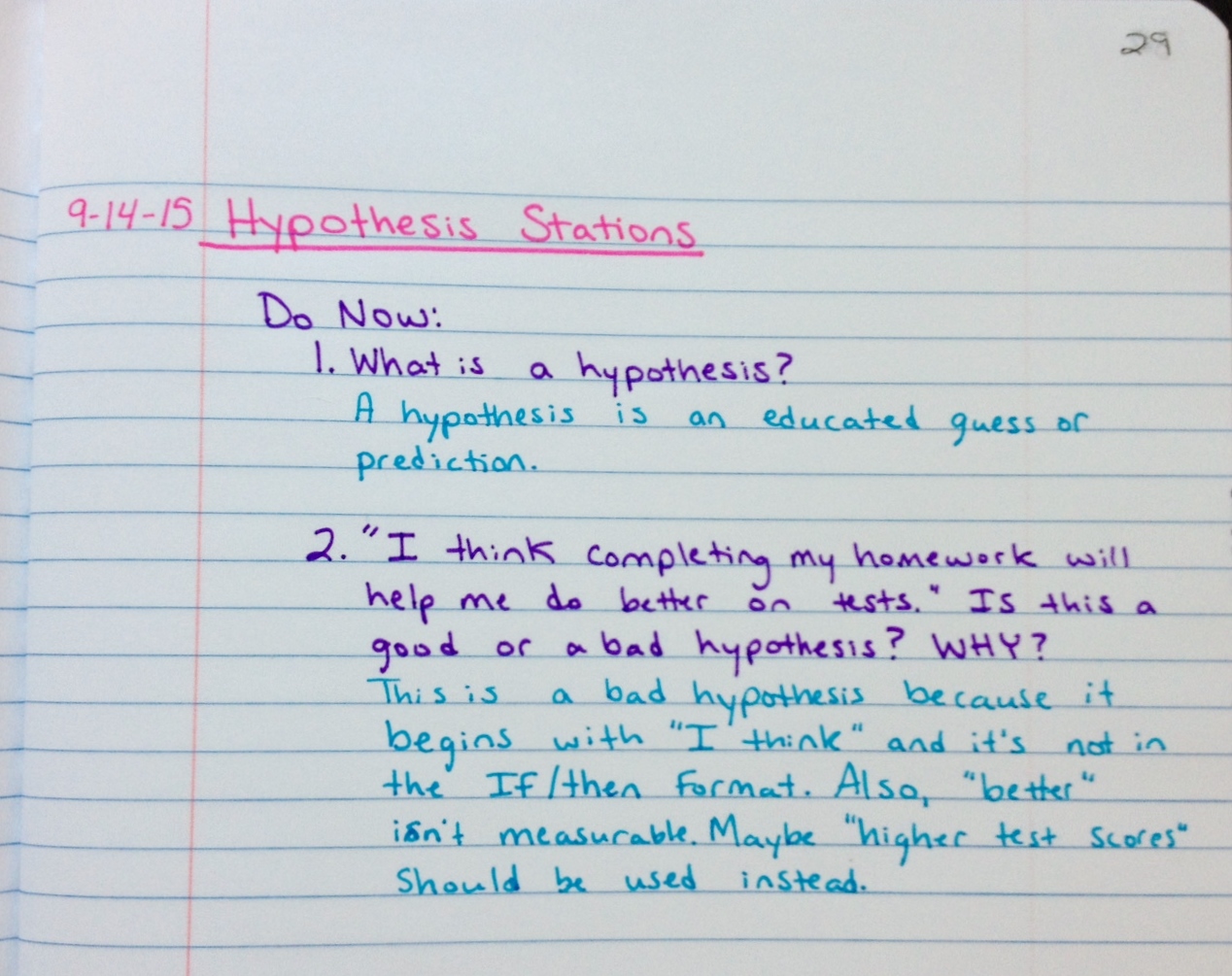
While I take roll call and take care of basic teacher housekeeping items, the students complete their Table of Contents and write the Do Now questions and answers in their INBs. I require students to write the questions in their INBs so they have potential test questions and answers to study in the future. Because the students need to work on their writing skills, they must answer the questions in complete sentences. The Do Now questions either review the previous lesson’s content or introduce the new content. To ensure students stay on task, I use a stopwatch to time their Do Now. Typically, I provide five minutes to complete the Do Now and add a minute or two if needed.  Here is a completed Do Now: 


When time is up, we discuss the answers together as a class. Students add to or change their answers as needed. Then we go over the day’s objective, rationale, and plan so students know what they are learning, why they are learning it, and how they’ll be learning it.

Well, that’s my beginning of class routine. It takes less than ten minutes, but it gets the class started without wasting learning time. The students’ minds get activated right away and ready to learn new content.

Thanks go to Desktop Learning Adventures and the ELA Buffet for setting up this blog hop. 


Analyzing Student Data with Stickers

One of the most important things I’ve learned about being an effective teacher is the importance of using student data in the classroom. Analyzing students’ results on assessments as a whole class tells me if I did an effective job teaching and what I need to work on in the future. When students look at their own results, they each see their areas of strength and areas of challenge. Analyzing data can be very time consuming and this can make it seem like it’s not worth it (especially when teachers have a mountain, or two mountains, of other things to do at any given time). In my own classroom, I’ve tried many different approaches, none of which I was particularly happy with. One day I was looking through my big box of stickers—I can never have enough stickers—and was inspired with an idea to use them to help students visualize their results. 

This method of data analysis all starts with how I organize the tests I use in my classroom. I always organize my tests by subtopics. For example, on a scientific method test I have headings like hypotheses, variables, and qualitative/quantitative observations. All of the questions pertaining to hypotheses will be found under that heading. This way, my students and I are able to quickly look at a section and see how well they understood it.

Take a look at my beginning/end of the year exam. You’ll notice the categories are all clearly laid out on the answer sheet. If you look at the picture of a page from the test, you’ll see the organization of the heading and questions. Having an organized test helps make data analysis much quicker.


After the students take the test and I grade their work, I dedicate about forty-five minutes of class time to analyze results with my students. This seems like a lot of time to look at data, but it gets the students motivated to do better. It shows them their growth and helps them reflect upon their study habits and become better future learners. It also shows the students who didn’t perform well on the test that they still have a good understanding in some areas (which helps prevent feeling like a failure, shutting down, and “not caring”). Also, during that forty-five minutes the students get needed practice with graphing and finding patterns in the results.

What do I do during that forty-five minutes? I start by having the students complete side one of a reflection sheet. (See the picture below.) Side one lists the topics covered in the test and shows each question number in each topic. For example, the Measurement questions on the test were numbers 11-20, so all of those numbers are listed under the Measurement heading.


Side one of the reflection sheet has students circle the question numbers they get correct and find the total number of questions correct for each topic. Then they calculate their percent correct on each topic. My students always need reminders of how to calculate percent, and I usually let them use the calculator on their phones for this.

Once side one of the reflection is completed, it’s time to determine best topics and most challenging topics. Side two of the reflection sheet helps with this. Side two has students consider their best and most challenging topics and try to determine the reasoning behind their success or misunderstanding.


Before class, I set up a poster or a group of papers with the test topics listed out. I sometimes divide each paper by class period or have separate posters for each class. Other times, I have all of the classes put their stickers on the same poster. 


Now it’s sticker time! I give all of the students two different colored stickers. You’ll need a lot of stickers for this so I buy some basic dot stickers to save money. This pack of 315 stickers costs about a dollar. I need two packs for my 200 students because I use only the blue and the red. Foil stars work well for this, too.


The blue stickers represent each individual student’s best topic. The red stickers represent his or her most challenging topic. Inevitably, I have students who have multiple best or worst topics. For those students, I tell them to select the topic that came easiest for them (for the blue sticker) or the topic that just never made sense to them (for the red sticker). The students who excelled on the test are still given a blue and a red sticker. The only exception I make to a student using both stickers is if the student feels very strongly that he or she had no challenging topic; then that student can just use a blue sticker on a favorite topic. Alternatively, you can have an additional topic on your poster that says “All” for students who aced the test. Students aren’t allowed to choose “All” for their red sticker because it feels too negative; there is always a topic that’s better than others.

After all of the stickers have been placed on the posters, we can quickly determine which topic is better than the others and which topic looks bloody. You can easily see on the posters below that the best topics are the Scientific Method and the Human Body. At a glance, you can tell the most challenging topics are measurement and either Genetics or Physical Science. 


We tally up the number of blue stickers and the number of red stickers for each topic. Then the students make a bar graph of the class’s results. We have a thorough discussion of possible reasons for the strengths of certain topics. (Potential reasons for success could be more time spent on that topic, a project or experiment that helped with understanding, or the level of interest students had.) We also discuss the likely reasons for the red topic. (Possible reasons could be difficult subject matter, more math involved, or many students being absent during that topic for weather or sports reasons.)


I like this method of data analysis because it is more student-centered. It’s not very time consuming for me. I don’t have to do much to analyze the data other than organize my tests a certain way and make some quick posters. Showing the results of tests using stickers makes it very easy for students to see their results and the results of the class. It gives them and me instant feedback that we can use to increase the understanding of content.

If you  have any questions about how to use this in your class, please comment below or send me a message using the Contact Me tab of my blog. My seventh grade science exam includes the reflection sheets seen on this blog and can be purchased at my Teachers Pay Teachers store. 

Secondary STEM Teachers

Teachers Pay Teachers has a huge amount of quality resources that can save you countless planning hours. When you look at the TPT site, sometimes is difficult to know where to begin.  If you're a secondary STEM teacher, start by checking out the stores below.

Giant Back to School Giveaway!

Hello everyone!

I've joined up with almost 100 other secondary sellers on Teachers Pay Teachers. We've put together several different packages you can win to prepare you for the 2015-2016 school year. These packages are huge! (Some packages are worth over $100!)

 Enter to win the giveaway!
Click here for more information and to enter to win.

Back to School SALE!

Hello everyone!

Teachers Pay Teachers is having a site-wide sale on Monday August 3rd and Tuesday August 4th. Everything in my store will be 20% off during these two days. If you use the promo-code "BTS15" at checkout you'll save even more money.

 BTS Sale

In my store you'll find many useful resources for the first week of school. I always give both a student survey and a parent/guardian survey in English and Spanish in the first couple of days of school. Another resource I use in the first week is the seventh grade science diagnostic exam so I get a good idea what my students already know and what they need to learn.

In the second week of school we start learning all about lab safety. This lab safety package can help you get your students ready for all of the fun experiments they'll do this year.

Make sure you check out the sale happening this Monday and Tuesday!